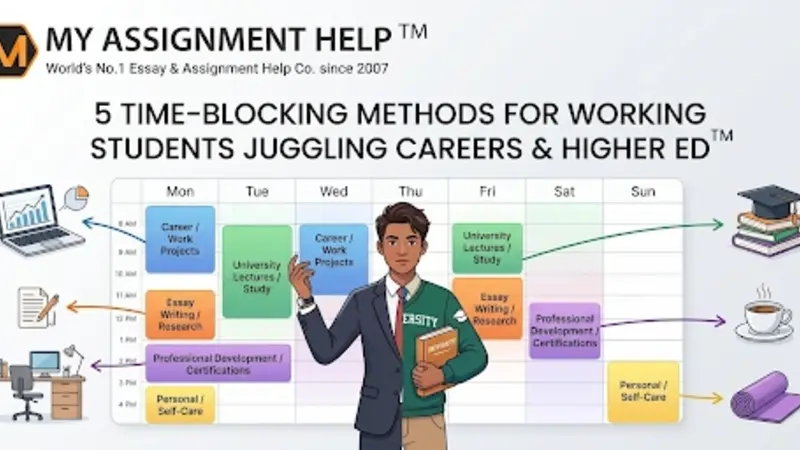
Mastering the Clock: 5 Time-Blocking Methods for Working Students Juggling Careers and Higher Ed
For the modern “working student,” time is not just money—it is the ultimate currency of survival. In 2026, the traditional boundary between the 9-to-5 professional world and the ivory tower of academia has blurred. According to recent data from the National Center for Education Statistics (NCES), over 70% of full-time undergraduates are also balancing significant work hours. When you are managing a career-track role while pursuing a degree, the “to-do list” often feels like a recipe for burnout rather than a roadmap to success.
The solution isn’t working harder; it’s working more intentionally. Enter Time Blocking. This productivity strategy involves carving out specific windows of time for dedicated tasks, effectively turning your calendar into a visual battlefield against procrastination. By assigning every minute a job, you eliminate “decision fatigue”—that draining feeling of wondering what to do next when you have both a corporate report and a research paper due at midnight.
Navigating this dual life requires high-level support, especially when deadlines collide. If you find yourself overwhelmed by complex essays or technical reports, utilizing a professional assignment writing service can provide the necessary breathing room to focus on your high-priority career milestones without sacrificing your GPA. This strategic delegation allows you to apply time-blocking more effectively to the areas of your life that require your unique expertise.
1. The “Day-Theming” Method
Day-theming is the heavy-duty version of time blocking. Instead of switching between work and study every few hours—which incurs a “context-switching” cost that can reduce productivity by up to 40%—you dedicate entire days to a specific theme.
- How it works: Assign Monday/Wednesday/Friday to your professional career tasks and Tuesday/Thursday/Saturday to your Higher Ed requirements.
- Best for: Students with flexible work schedules or those in research-heavy programs like those seeking child development research topics who need deep, uninterrupted focus.
- Data Point: A study by the American Psychological Association (APA) suggests that multitasking is a myth; “switching” actually wastes more time than it saves. Day-theming eliminates this switch entirely.
2. The “Time-Boxing” Method
While time blocking sets aside time, Time-Boxing limits it. You decide that a task must be finished within a specific “box” of time.
- How it works: Instead of saying “I’ll study for two hours,” you say “I will finish my data analysis report between 6:00 PM and 8:00 PM.” Once the box is closed, you move on.
- Best for: Perfectionists who spend too much time polishing one assignment at the expense of others.
- Expert Tip: Use this for “shallow work” like answering emails or formatting citations to ensure they don’t bleed into your “deep work” hours.
3. The Pomodoro-Block Hybrid
For the working student, the 25-minute Pomodoro is often too short for complex academic synthesis. A hybrid approach uses longer “Power Blocks.”
- How it works: Set a 90-minute block for intense focus (study or work), followed by a 20-minute break.
- Why it works: Human brains naturally cycle through “ultradian rhythms.” Every 90–120 minutes, our brain requires a period of rest to maintain cognitive performance.
- The Schedule: * 09:00 – 10:30: High-Intensity Work Project
- 10:30 – 10:50: Break (No screens!)
- 10:50 – 12:20: Academic Research/Writing
4. “Front-Loading” (The Eat the Frog Method)
Named after Mark Twain’s famous quote, this method dictates that you tackle your most dreaded task first thing in the morning.
- How it works: If you have a difficult exam to study for, do it at 6:00 AM before your work shift begins.
- Impact: By the time you start your “work day,” the mental weight of your hardest academic task is already gone, providing a psychological “win” that fuels your professional performance.
5. Task Batching
Task batching is the practice of grouping similar, small tasks together to perform them in one dedicated block.
- How it works: Don’t answer emails as they come in. Batch them for 4:00 PM. Don’t look up citations one by one; batch all research for a 2-hour window on Saturday.
- Efficiency: This maintains a “flow state,” which researchers at McKinsey found can make professionals 500% more productive.
Key Takeaways
- Context Switching is the Enemy: Moving rapidly between “Work Brain” and “Study Brain” kills efficiency.
- Prioritize Deep Work: Use 90-minute blocks for tasks that require high cognitive load.
- Be Realistic: Always leave “buffer blocks” (30-60 minutes) in your calendar for unexpected work meetings or family needs.
- Leverage Support: Don’t be afraid to outsource routine tasks when your schedule reaches a breaking point.
FAQ Section
Q1: How do I handle unexpected overtime at work when I have a block scheduled for studying?
A: Use the “Conditional Blocking” rule. Always have a “Backup Block” on your weekend. if a weekday block is lost to work, it automatically moves to the Saturday morning slot.
Q2: Is time blocking better than a traditional to-do list?
A: Yes. A to-do list tells you what to do; time-blocking tells you when you will do it. This creates accountability and prevents over-commitment.
Q3: Can I use digital tools for this?
A: Absolutely. Google Calendar is excellent for visual blocking, while apps like Notion can help you store the specific “Task Batches” within those blocks.
References
- American Psychological Association (2024). “Multitasking: Switching Costs.”
- National Center for Education Statistics (2025). “The Condition of Education: College Student Employment Trends.”
- Newport, C. (2016). “Deep Work: Rules for Focused Success in a Distracted World.”
- McKinsey & Company (2023). “The Productivity Premium of Flow States in Professional Environments.”
Author Bio
Dr. Sarah Jenkins is a Senior Academic Consultant at MyAssignmentHelp. With over a decade of experience in instructional design and SEO strategy, she specializes in helping students optimize their learning workflows and navigate the complexities of 2026’s digital-first academic landscape. When she isn’t auditing content for E-E-A-T compliance, she’s mentoring working professionals on sustainable career-education balance.